VR onboarding : the virtual reality guide for HR teams
Learn what onboarding means for HR, what a poor onboarding really costs, and how virtual reality and the Inversive Lobby help you retain new talent
VR onboarding: definition and the value of virtual reality
You've just hired a qualified candidate. The contract is signed, the equipment is ready. Yet the real HR challenge is only beginning: making sure this new hire settles in, understands your company culture and, above all, decides to stay. Did you know that, on average, nearly 20% of employee turnover happens within the first 45 days after hiring? (source) The key to stopping this loss of talent is a well-defined process.
Look up a definition of onboarding and one thing quickly becomes clear: the traditional welcome booklet and a quick office tour no longer meet employees' expectations. With hybrid work, geographically dispersed teams and pressure on profitability, onboarding has to be reinvented.
This article breaks down the financial stakes of traditional onboarding and shows how virtual reality (VR) is becoming a key operational tool to structure, standardize and improve the way you welcome new talent.
Onboarding: definition and strategic stakes for HR
What does onboarding really mean?
"Onboarding" refers to the structured process of welcoming a new employee and helping them adapt to a company. It goes far beyond a single morning of introductions. It is a strategic journey that spans several months and rests on three core pillars :
Administrative and practical onboarding: Signing contracts, handing over IT equipment, setting up access and touring the premises.
Operational onboarding: Job-specific training, getting to grips with internal tools, learning business processes and setting clear short- and medium-term goals.
Social and cultural onboarding: Absorbing the company's values, understanding the brand's history and building relationships with managers and coworkers.
The hidden cost of poor onboarding
For HR departments and business leaders, onboarding has a direct impact on profitability. Yet according to Gallup, only 12% of employees strongly agree that their organization does a great job of onboarding new employees (source Gallup).
A poor onboarding process almost inevitably leads to lower engagement and early turnover. And the financial consequences of a failed hire are heavy. The Society for Human Resource Management (SHRM) estimates that replacing an employee costs a company between 50% and 200% of that person's annual salary (source SHRM). These costs include recruitment agency sourcing fees, time spent by managers, lost productivity while the position is vacant and the negative impact on the morale of existing teams.
The numbers speak for themselves: onboarding isn't an HR cost, it's an investment.
The limits of traditional onboarding
Despite these financial stakes, many organizations still rely on onboarding methods that struggle to hold new hires' attention. The traditional model now shows clear operational limits.
"Death by PowerPoint" and cognitive overload
An employee's first days are too often filled with endless information sessions. Swamped by a stream of top-down, theoretical presentations, the new hire suffers from cognitive overload. Information retention is low, attention drops and initial motivation fades. This is where passive learning shows its weaknesses.
Generic programs and a lack of engagement
To save time, HR teams tend to over-standardize their processes. Onboarding programs lose what makes them distinctive. The company's DNA, its culture and what sets it apart in its market get buried under heavy paperwork. The new hire doesn't feel personally expected.
The logistical challenge of scaling up
This is the biggest hurdle for fast-growing companies, multi-site industrial groups and remote-friendly organizations. How do you guarantee fair treatment and the same quality of onboarding for an engineer hired in Paris and a sales rep hired in Lyon on a fully remote basis?
Organizing visits to secure industrial sites, getting executives involved with every new cohort or managing travel all generate significant logistical costs and lost time.
Immersive onboarding: how VR changes the experience
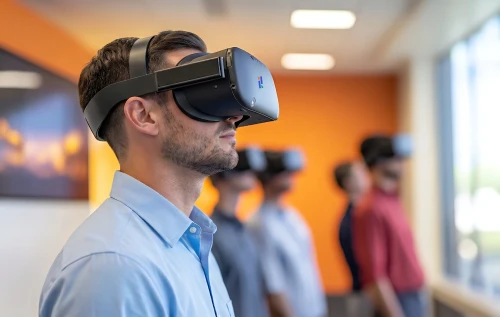
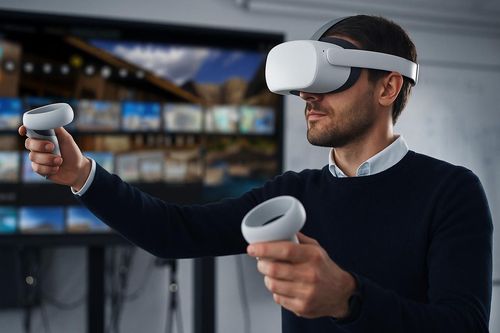
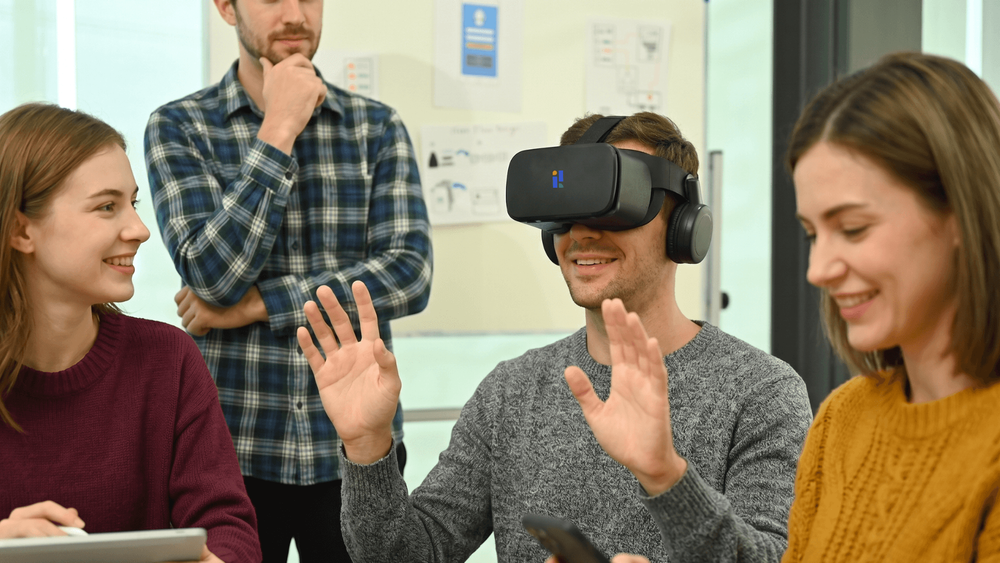
To solve these logistical and cognitive problems, virtual reality is increasingly part of HR development strategies. Immersive onboarding isn't meant to replace human contact. Its goal is to optimize the onboarding experience by using VR headsets to immerse employees at the heart of the company, in an active and measurable way.
360° virtual tour of the premises
With virtual reality, geographical constraints disappear. A new employee based in Bordeaux can take a virtual tour of the head office in La Défense. Better still, they can explore a secure production line or a restricted-access area in an immersive way, without prior safety training or costly travel.
Meeting the teams and passing on the culture
VR makes it possible to script immersive meetings with leadership or subject-matter experts who are hard to bring together day to day. It's an opportunity to convey the company's history and values with far greater emotional impact and recall than reading an intranet page.
Hands-on practice and long-term retention (learning by doing)
Instead of reading a procedures manual, employees are placed in a realistic, simulated work environment. They practice for real, perform the right actions and can make mistakes safely. Whether it's handling technical equipment, a hazard spotting exercise or dealing with a difficult customer (soft skills), learning by doing ensures optimal knowledge retention.
What our clients consistently observe: a headset demands a level of attention that PowerPoint simply can't force.
To see how these environments can structure your teams' day-to-day training, check out our blog post
Case study: the Inversive Lobby to reinvent onboarding
Where many solutions simply provide generic training modules, Inversive has developed a technological approach designed specifically around companies' brand identity requirements: the Inversive Lobby.
A virtual reality welcome space that reflects your brand
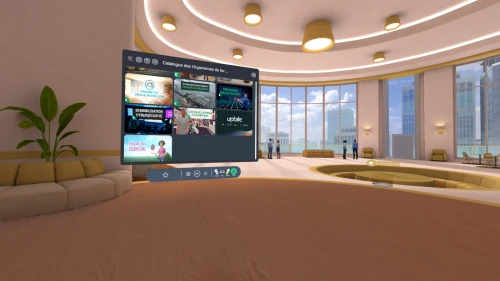
The Lobby works like a true virtual campus. It's a welcome space fully customized to reflect your company. As soon as a new employee puts on their VR headset, they don't land in a complex technical menu or on a neutral interface. They're immediately immersed in your brand's world: your colors, your logos and a 3D environment designed for you.
Why choose the Inversive Lobby for your HR journey?
A standout first impression: You instantly show that your organization invests in cutting-edge technology and in the employee experience.
A centralized content hub: This customized welcome space serves as an intuitive starting point. From the Lobby, new hires go straight to the tour of your premises, safety training modules or messages from leadership.
Deployment at scale and technical management
One of the most common barriers to VR adoption in companies is hardware management. How do you update 50 headsets deployed across 10 different sites? Inversive's strength lies in its technical platform, which combines a CMS (Content Management System) and an MDM (Mobile Device Management) built for extended reality (XR).
With this tool, you manage your headset fleets remotely, launch experiences simultaneously and analyze your employees' usage statistics in real time. Data is hosted in Europe, in a Tier 4 datacenter near Paris under EU jurisdiction, ensuring strict GDPR compliance.
To see what our immersive welcome hub can do, visit the Platform page.
FAQ
1. What is onboarding?
Onboarding is the strategic process of integrating a new employee into a company. It covers sharing administrative information, job-specific operational training and social integration into the organization's culture and teams.
2. Why is onboarding important?
This process has a direct impact on performance and talent retention. Structured onboarding drastically reduces turnover, limits the hidden costs of failed hires and helps employees become productive faster.
3. How long does onboarding last?
While the practical welcome phase lasts a few days, a real onboarding process usually spans 3 to 6 months (sometimes up to a year). This time is needed for employees to fully build their skills and successfully adapt to the company culture.
4. How do you run effective remote onboarding?
Effective remote onboarding requires clear processes, regular video check-ins and high-performing digital tools. Virtual reality is increasingly popular for rebuilding social connections, simulating technical tasks and letting new hires tour the premises despite the physical distance.
5. Can VR improve onboarding?
Yes. Virtual reality replaces passive learning (presentations, manuals) with immersive, active and memorable hands-on scenarios. It captures 100% of the employee's attention, reinforces retention through practice and standardizes onboarding quality at scale.
6. How much does VR onboarding cost?
The initial investment covers hardware (headsets) and content creation or licensing. However, compared to the recurring logistical costs of traditional onboarding (travel, trainer time) and the very high cost of turnover, immersive onboarding generally pays for itself within a few months, thanks in part to affordable licensing models (from €8/month per user with Inversive).
Ready to transform how you onboard new talent and reduce turnover?
Build your immersive onboarding journey with Inversive. Request a free demo