Virtual reality training : A guide for businesses
Bring virtual reality training into your company. Use cases, budget, deployment and ROI : the complete B2B guide to a successful immersive project.
Virtual reality training is no longer an experiment confined to R&D labs. Immersive technologies are now a lasting part of HR practices for HR departments, training managers and IT leaders. As traditional learning methods and conventional e-learning show their limits, immersion powered by extended reality (XR) offers an operational way to keep learners engaged.
This guide is for decision-makers who want to structure and roll out an immersive project. We cover the market data, the use cases that pay off, the real costs and the method for integrating these new learning paths into your overall strategy.
Why train in virtual reality?
Enterprise XR adoption is accelerating because it directly improves information retention and employee upskilling.
According to a 2022 PwC study, 42% of companies have already adopted the technology, and learners report a 275% increase in confidence when applying the skills they learned after training (PwC source).
In practice, VR (virtual reality) lets you :
Make learning safe : mistakes have no physical or financial consequences in a virtual environment.
Cut logistics costs : no need to shut down a production line or send trainers and teams to a remote site.
Maximize attention : once the headset is on, the learner is cut off from outside distractions (phone, email).
VR training use cases
An immersive project stands or falls on the choice of use case. These are the areas where ROI is quickest to demonstrate.
Safety and risk prevention (HSE)
This is where VR excels. Simulating a fire outbreak or an industrial accident in the real world is complex and dangerous. Virtual reality makes it possible to run hazard hunts that can be repeated indefinitely, without tying up the production site, while precisely measuring how employees react to danger.
Mastering hands-on technical skills and maintenance
In industry, virtual simulation lets teams rehearse maintenance or quality control procedures before working on real, expensive equipment. This significantly strengthens technical skills acquisition and muscle memory.
Immersive onboarding and integration
New-hire onboarding can be optimized with VR. Instead of a day of theory-based presentations, immersive onboarding lets new employees tour the premises virtually, meet teams remotely on a virtual campus and work through interactive role-play scenarios.
Soft skills and customer relations
VR is remarkably effective for conflict management, public speaking and diversity training. Some modules let learners step into different roles to build empathy in sensitive workplace situations.
Crisis simulation
Preparing leadership or operational teams for cyberattacks, media crises or natural disasters requires high-pressure environments, which VR simulates with a high degree of realism.
How does it work in practice?
For an IT director or training manager, this kind of project needs to be structured and controlled end to end. It rests on four core pillars.
Choosing the hardware (VR headsets)
The professional market is now built around reliable manufacturers. Corporate fleets are mostly equipped with Meta Quest, Pico or HTC Vive headsets. The choice will depend on IT security constraints and the processing power your applications require.
Creating or acquiring content
You have two options :
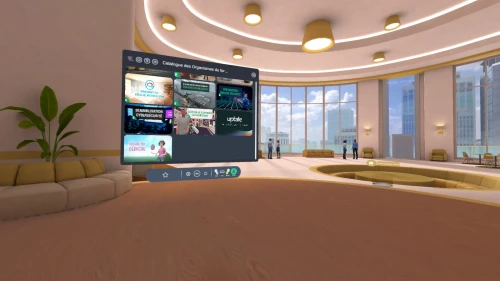
Off-the-shelf catalog : turnkey modules (safety, onboarding) that can be deployed immediately.
Custom studio : experiences built around your internal processes (digital twins of your machines).
Explore the Inversive off-the-shelf experience catalog now.
Deployment and technical management
This is often the sticking point when scaling up. How do you manage 50 headsets spread across several sites?
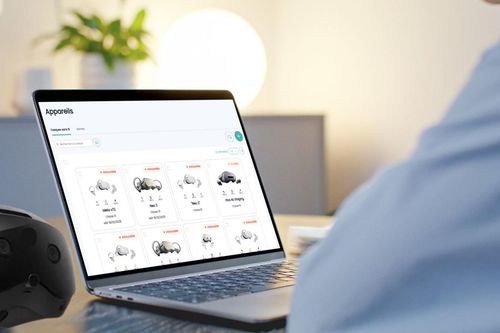
You need a technical platform that combines a CMS (content management system) to store experiences and an MDM (mobile device management) to control headsets remotely and push module updates across the entire fleet.
Tracking and data analysis (LRS)
The delivery platform must report usage statistics : completion rate, time spent, errors made, areas viewed. This data provides objective evidence of skills acquisition.
VR training vs traditional training : an honest comparison
Virtual reality does not replace trainers or e-learning; it fits into a blended learning strategy. More and more training providers use it alongside in-person sessions to meet specific learning objectives.
Here is a transparent comparison of its strengths and limitations :
| Criterion | Classroom training (in person) | Traditional e-learning | Virtual reality training |
|---|---|---|---|
| Learner engagement | Varies with the trainer | Often low (distractions) | Very high (full immersion) |
| Upfront cost | Low (but high recurring costs) | Moderate (module creation) | High (hardware + creation/licenses) |
| Scalability | Complex (heavy logistics) | Very easy | Easy (with an XR MDM) |
| High-risk scenarios | Impossible or simulated in theory | Theory only | Realistic and 100% safe |
| Content updates | Fast | Moderate | Requires technical adjustments |
What budget for VR training?
Calculating the ROI of a virtual reality training project means accounting for three cost items :
Hardware : a professional VR headset costs between €300 and €1,000 depending on the model (e.g., Pico 4 Enterprise or Meta Quest 3). It is an upfront investment that can be depreciated.
Software licenses (platform) : to manage the fleet and deliver content, plan for a SaaS subscription. For example, Inversive platform pricing starts at €8 per user per month.
Content (software) : buying licenses for off-the-shelf modules is a cost-effective way to get started. Custom development by a studio requires a larger investment, justified for specific industrial processes.
How to start a VR training project
A successful XR rollout relies on an iterative approach :
Identify a measurable pain point : choose a process where current training is too costly, dangerous or ineffective (workplace accident rate, turnover during onboarding).
Select a pilot group : roll out the solution to a small sample of employees and compare their results with a group trained the traditional way.
Rely on a complete ecosystem : avoid juggling multiple vendors. Choose a solution that brings together content creation (Studio), ready-to-use modules (Catalog) and technical management (CMS/MDM).
As a European software vendor with 10 years of expertise, Inversive supports you across this entire value chain, with hosting in Europe and native GDPR compliance.
Frequently asked questions (FAQ)
1. How much does virtual reality training cost?
Cost depends on the approach : professional headsets come with a management license (from €8/month per headset with Inversive), plus the cost of modules (off-the-shelf licenses or custom development).
2. What are the benefits of VR training?
It provides a 100% safe learning environment, maximizes engagement by cutting learners off from distractions, reduces logistics costs and significantly improves memory retention.
3. Which VR headset should you choose for training?
Most organizations opt for standalone headsets to simplify deployment. Meta Quest, Pico and HTC Vive models are the benchmarks in the B2B market.
4. Is VR effective for training?
Yes. Studies show faster learning times and a strong increase in employees' confidence when applying the skills they learned on the job.
5. How do you create a VR training module?
You can build modules in-house if you have 3D developers, or work with a specialist studio (such as Inversive's) to design custom interactive experiences that meet your specifications.
6. Can VR training be funded through an OPCO?
Yes. In France, OPCOs (industry bodies that fund employee training) can cover it if the virtual reality training modules are part of a certifying or qualifying learning path and the provider meets the Qualiopi criteria (OPCO EP source).
7. How long does a VR training session last?
To avoid visual or cognitive fatigue, an optimal immersive session usually lasts 15 to 30 minutes. This short format is ideal for rehearsing precise procedures.